
Carbon Credit Trading Scheme
India’s Market-Based Approach to Decarbonization
Aligning with India’s climate commitments under the Paris Agreement
What is Carbon Credit Trading Scheme
The Carbon Credit Trading Scheme (CCTS), 2023 introduced under the Energy Conservation (Amendment) Act, 2022, to establish the Indian Carbon Market (ICM), aligning with India’s climate commitments under the Paris Agreement.
A CCTS Audit under India’s Carbon Credit Trading Scheme is all about making sure companies know exactly how much greenhouse gas (GHG) they’re putting out and are actively working to keep those emissions within specified targets. The end goal? If an organization does better than its target, it gets carbon credits it can trade; if it falls short, it must surrender credits or face penalties.
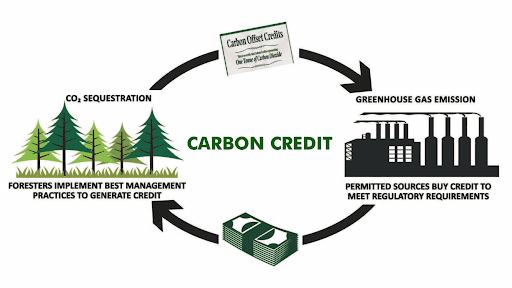
The Carbon Credit Trading Scheme (CCTS) is a market-based mechanism introduced under the Indian Carbon Market (ICM) to regulate and facilitate the trading of carbon credits. Its primary objective is to decarbonize the Indian economy by assigning a price to greenhouse gas (GHG) emissions and enabling entities to trade emission reductions efficiently. The scheme issues Carbon Credit Certificates (CCCs), each representing a reduction of one tonne of CO2 equivalent (tCO2e).

Two Key Mechanisms
Compliance Mechanism
For Energy-Intensive Sectors
- This mechanism is applicable to energy intensive sectors such as aluminium, cement, iron & steel, textiles, petrochemicals, and others. These obligated entities are targeted to reducing their GHG emission intensity (emissions per unit of production), these targets are set by the Bureau of energy efficiency (BEE).
- Entities that reduce their emissions below their target are issued by Carbon Credit Certificates (CCCs).
- Entities that fail to meet their targets must purchase CCCs from those who have generated surplus credits.
Offset Mechanism
For Non-Obligated Sectors
- This mechanism is applicable to those energy sector which are non- obligated, including those sectors like Agriculture, Forestry, Transport, Construction, Fugitive Emission and others.
- So, these entities can register projects and aimed to reducing or removing GHGs from the atmosphere. These projects can be certified and generate CCCs if they reduce or remove GHG emissions from atmosphere.
- These credits are then available for purchase by obligated entities to meet their compliance obligations, and for others wishing to offset their voluntary emission
Carbon Pricing Approaches
Governments typically implement carbon pricing through three main approaches
Emissions Trading System
This involves a cap-and-trade or baseline-and-credit mechanism. Cap-and-trade sets an emission limit, allowing companies that emit below the cap to sell their excess allowances to those exceeding it. Baseline-and-credit rewards companies that reduce emissions below a predefined baseline by allowing them to sell credits.
Carbon Tax
This imposes a fixed tax on each ton of CO2 emitted. Unlike ETS, it does not guarantee a specific emission reduction but incentivizes companies financially to reduce emissions.
Crediting Mechanism
This allows projects that reduce GHG emissions to generate carbon credits, which can be sold domestically or internationally for compliance or voluntary mitigation.
CCTS combines these mechanisms in a structured and regulated framework, ensuring transparency, accountability, and incentivizing a cost-effective transition to a low-carbon economy while aligning with India’s climate goals.
Unlocking the Power of Carbon Credits
Carbon credits are vital tools in the fight against climate change.
How the CCTS Audit Works
Governments typically implement carbon pricing through three main approaches
The audit starts with a baseline assessment, where an accredited agency checks and records a company’s GHG emissions for a reference year. This sets the benchmark against which future emissions are measured.
Next comes the monitoring plan. Companies must spell out (and submit) exactly how they’ll measure their emissions what tools, methods, and processes will be used, how often, and for which activities. The plan should capture data continuously and periodically for thoroughness.
Every year, all emissions data is collected and compiled into a comprehensive GHG report. This includes details about operations, production processes, and emission sources for the financial year (April–March). Within four months of year-end, the company sends all this data complete with forms and compliance proformas to the Bureau of Energy Efficiency (BEE) and their State Designated Agency for review.
Then, an independent, BEE-accredited verification agency steps in for a detailed check. The agency audits all the submitted documentation, raw data, and monitoring systems to make sure everything is accurate and compliant.
If any problems or non-compliance is found, the company must sort it out, and a revised, verified report is sent. The BEE can order extra reviews if needed even a second, independent audit in certain cases.
After a successful audit, if a company’s emissions are under the official limits, it receives carbon credit certificates (CCCs). These certificates are recorded, approved, and issued, then can be traded on regulated power exchanges, offering market value for sustainability. If emissions exceed targets, credits must be surrendered, or penalties can apply.
Key Documentation
Emission Monitoring Plan
This is the roadmap for measuring emissions documenting equipment, boundaries (what’s included/excluded), and methodologies.
GHG Reduction Action Plan
A long-term strategy (at least five years) for cutting emissions, including specific actions, costs, and implementation timelines.
Verification Certificate
An official document from the accredited agency stating the company’s data and actions meet the required standards.
Enforcing Compliance
If a company goes over the emissions limit, it’s required to surrender enough CCCs to cover the overage or face regulatory action. Persistent failures can mean exclusion from the market or financial penalties enforced by authorities.
Our Track Record in CCTS Audit
We have successfully completed the Carbon Credit Trading Scheme (CCTS) audit for 25 textile industries and 40 iron & steel industries.
Iron & Steel Industries
ArcelorMittal Nippon Steel India Limited, Surat, Gujarat
TATA Steel BSL Limited, Raigad, Maharashtra
Welspun Steel Limited, Kutch, Gujarat
Vedanta Limited (Value Added Business -Iron Ore Business)
JSW Steel Coated Product Ltd., Vasind, Maharashtra
Gallantt Metal Limited, Kutch, Gujarat
Textile Industries
Grasim Industries Limited, Bharuch, Gujarat
Aaiswarya Dyeing Mills Pvt Ltd, Surat, Gujarat
Aarvee Denims & Exports Limited, Unit – I.
Anubha industries, Surat, Gujarat
Bindal Silk Mills Private Limited, Surat, Gujarat
CREATIVE TEXTILE MILLS PVT., Valsad, Gujarat
Get In Touch
Ready to start your DISCOM energy audit? Contact our experts today.
Call Now
Address:-
Corporate Office :
B-801, 8th Floor, Tower-4, Plot No 17, N X One, Kisan Chock, Sector Techzone-4,Greater Noida (West) – 201318 U.P.
Login / E-Store
Get In Touch
- Phone No: 0120-6056188
- Mobile No: 9711591550
- Email: info@ecoenergies.co.in
Corporate Office :
B-801, 8th Floor, Tower-4, Plot No 17, N X One, Kisan Chock, Sector Techzone-4,Greater Noida (West) – 201318 U.P.
Copyright © 2025 Ecoenergies. All Rights Reserved