
Carbon Border Adjustment Mechanism (CBAM)
Carbon Border Adjustment Mechanism (CBAM)
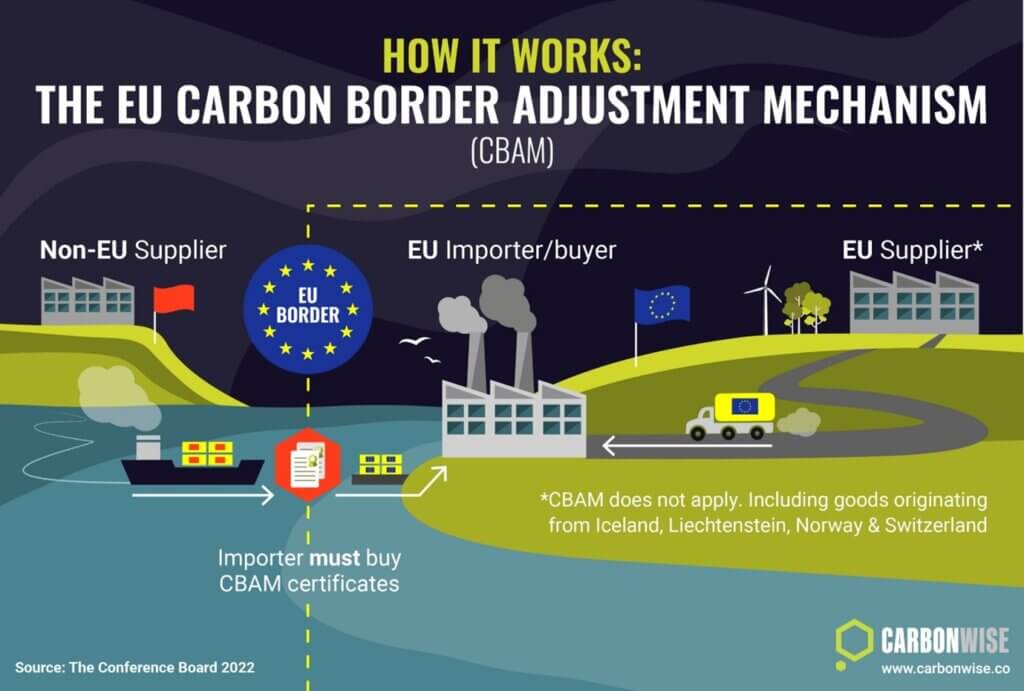
The Carbon Border Adjustment Mechanism (CBAM) is a major climate policy introduced by the European Union to stop “carbon leakage.” It works by placing a tax on imported products that generate high greenhouse gas emissions. This ensures that foreign goods are treated the same as EU-made goods, which already follow strict carbon pricing rules under the EU Emissions Trading System (ETS).
The main purpose of the CBAM is to make sure that imported goods face the same carbon costs as products made within the EU. This helps prevent EU companies from shifting their high-emission production to countries with weaker climate rules just to avoid paying carbon charges—a problem known as carbon leakage. The policy also supports the EU’s “Fit for 55” plan, which aims to cut greenhouse gas emissions by at least 55% by 2030 compared to 1990 levels.
By assigning a fair carbon cost to imported goods, the CBAM encourages countries outside the EU to adopt or improve their own carbon pricing policies or to reduce emissions in their industries.
If a foreign producer can show that they already paid a carbon price in their own country, that amount can be subtracted from what they owe under the CBAM in the EU.

Mechanism and Implementation
Under the CBAM, companies that import certain goods into the EU must buy and submit CBAM certificates. The cost of these certificates is tied to the weekly average price of EU ETS carbon allowances, measured in euros per tonne of CO₂ emissions.
The mechanism is being implemented in phases:
- Transitional Period (October 1, 2023 – December 31, 2025)
This is a reporting-only phase. Importers don’t have to make any payments yet, but they must submit quarterly reports showing:
- how much of each covered product they imported, and
- the amount of greenhouse gas emissions linked to those products (mostly direct emissions, and sometimes indirect emissions too).
- Definitive Regime (Starting January 1, 2026)
From 2026 onward, importers will need to:
- report the total embedded emissions of their imported goods each year, and
- surrender the matching number of CBAM certificates to cover those emissions.
Scope of Products
The CBAM initially focuses on a select number of goods at high risk of carbon leakage, which are highly traded and carbon intensive. These include:
-
Iron and steel
-
Cement
-
Aluminium
-
Fertilizers
-
Electricity
-
Hydrogen
- The scope is expected to gradually expand to include more ETS products by 2030, potentially incorporating organic chemicals and polymers in the future.
How Can CBAM Impact India?
1. Impact on India’s Exports
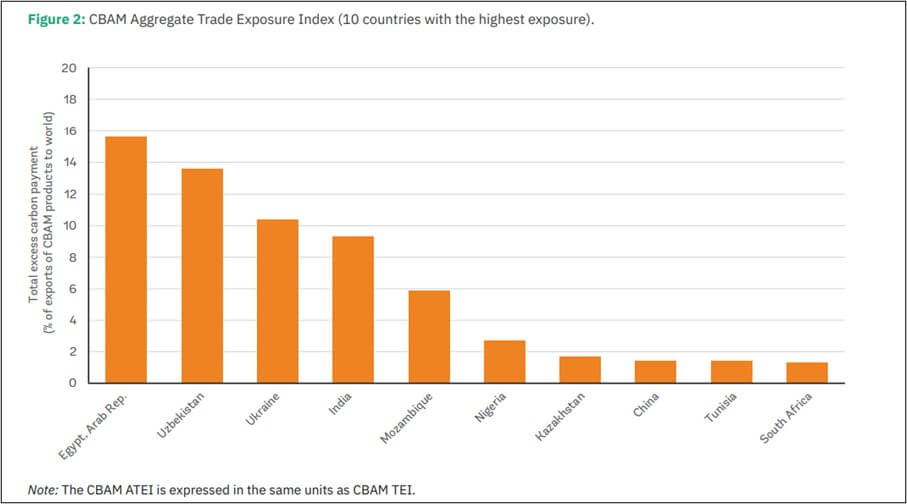
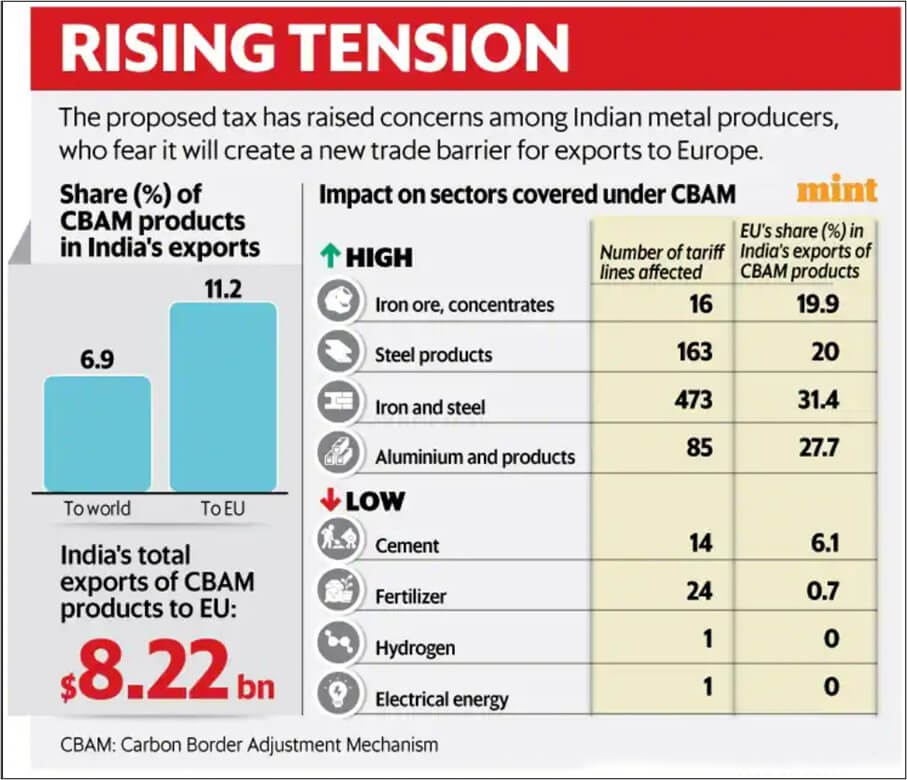
CBAM is expected to create challenges for India’s metal exports—especially iron, steel, and aluminium—because these products will be closely examined for their carbon emissions. Many of India’s major exports to the EU, such as iron ore and steel, could become less competitive due to carbon taxes that may range from 19.8% to 52.7%.
Starting January 1, 2026, the EU will begin charging a carbon tax on every shipment of steel, aluminium, cement, fertilizers, hydrogen, and electricity entering the EU market.
2. Carbon Intensity and Higher Tariffs
Indian products generally have a higher carbon footprint than those produced in the EU. This is mainly because India relies heavily on coal for its energy needs—about 75% of India’s electricity comes from coal, compared to 15% in the EU and 36% globally.
As a result, the iron, steel, and aluminium sectors produce higher emissions, which means Indian exporters will have to pay higher carbon tariffs under CBAM.
3. Risk to Export Competitiveness
While CBAM will initially apply to a limited number of sectors, it may later expand to others—such as refined petroleum products, organic chemicals, pharmaceutical products, and textiles. These items are already among the top goods that India exports to the EU.
Another challenge is that India does not currently have a domestic carbon pricing system. Countries that do have such systems may receive exemptions or pay lower CBAM charges, placing Indian exporters at a disadvantage.
Why Choose Namdhari Eco Energies ?
Your most reliable partner for accurate, compliant, and transparent services.
We bring specialized expertise to help Carbon Border Adjustment Mechanism (CBAM) achieve top-tier certification with confidence.
First Movers
Domain Expertise
End-to-End Support
Regulatory Alignment
Carbon Reduction Roadmaps
Proven Track Record
Get In Touch
Ready to start your DISCOM energy audit? Contact our experts today.
Login / E-Store
Get In Touch
- Phone No: 0120-6056188
- Mobile No: 9711591550
- Email: info@ecoenergies.co.in
Corporate Office :
B-801, 8th Floor, Tower-4, Plot No 17, N X One, Kisan Chock, Sector Techzone-4,Greater Noida (West) – 201318 U.P.
Copyright © 2025 Ecoenergies. All Rights Reserved