
Green Audit of Universities for NAAC
Green Audit of Universities for NAAC
A Green Audit for NATIONAL ASSESSMENT AND ACCREDITATION COUNCIL (NAAC) is an environmental checkup that colleges and universities must carry out as part of the accreditation process under Criterion 7: Institutional Values and Best Practices. It looks at how the campus uses resources like water and energy, how it manages waste, and how well it protects biodiversity.
The audit involves collecting data, visiting different areas of the campus, and studying the findings to understand what the institution is doing well and where it can improve. The main goal is to help the campus reduce its carbon footprint, use resources more wisely, and encourage everyone to be more environmentally aware.
The NATIONAL ASSESSMENT AND ACCREDITATION COUNCIL (NAAC) conducts assessment and accreditation of Higher Educational Institutions (HEI) such as colleges, universities or other recognised institutions to derive an understanding of the ‘Quality Status’ of the institution. NAAC evaluates the institutions for its conformance to the standards of quality in terms of its performance related to the educational processes and outcomes, curriculum coverage, teaching-learning processes, faculty, research, infrastructure, learning resources, organisation, governance, financial well-being and student services.
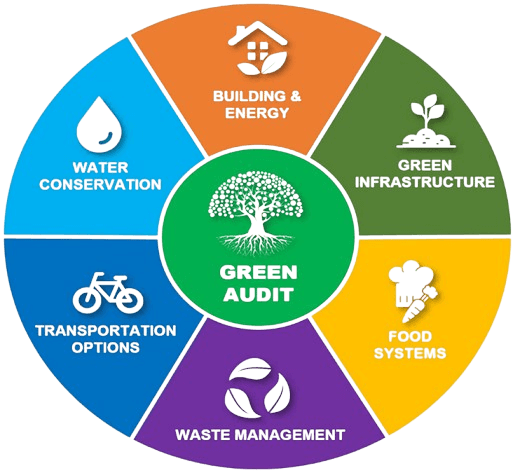
Purpose and Objectives
The primary goal of a green audit is to assess the environmental performance of the institution and promote an eco-friendly ambiance on campus. Key objectives include:
-
Baseline Reporting: Preparing a report on existing biodiversity and resource consumption patterns.
-
Resource Management: Monitoring the consumption of energy and water to identify areas for conservation and cost savings.
-
Waste Management: Assessing the type and volume of waste (solid, liquid, e-waste, hazardous) to improve minimization and recycling plans.
-
Awareness: Fostering environmental consciousness, values, and ethics among staff and students, thus developing a sense of social responsibility.
Methodology and Focus Areas
The audit process involves a systematic evaluation of various environmental aspects. An external, recognized auditing body usually conducts this assessment, collaborating with an internal green audit team comprising faculty and students.
The main focus areas are:
Water Conservation: Evaluating facilities for rainwater harvesting, borewell recharging, wastewater recycling, and overall water usage.
Energy Management: Monitoring consumption patterns and assessing the use of alternate/renewable energy sources and energy-conservation measures.
Waste Management: Reviewing infrastructure and practices for the proper handling of degradable and non-degradable waste.
Green Campus Initiatives: Documenting tree plantation drives, campus biodiversity, and initiatives to reduce the institution’s carbon footprint.
Significance for NAAC Accreditation

Benefits of a NAAC Green Audit Report
The NAAC Green Audit Report gives a complete picture of how environmentally sustainable an institution is. It not only points out what the institution is doing well, but also shows where improvements are needed. Here are some key benefits:
Helps Identify Areas for Improvement
The Green Audit closely examines key sustainability areas such as energy and water conservation, waste management, and green initiatives.
It provides a detailed assessment of performance and clearly highlights where corrective actions or improvements are needed, helping institutions plan effective strategies to reduce environmental impact.
Boosts the Institution’s Reputation
A strong NAAC Green Audit Report enhances the institution’s public image by demonstrating a clear commitment to environmental responsibility.
Such recognition attracts students, faculty, and donors who value sustainability and eco-friendly practices.
Opens Doors to Funding Opportunities
Institutions with good Green Audit results are more likely to receive grants, donations, and partnerships from organizations supporting sustainability.
This funding helps institutions invest in green infrastructure and initiatives that further strengthen long-term environmental performance.
Register for the Green Audit
Institutions interested in undergoing a Green or Environmental Audit must begin by completing the registration process.
During registration, basic details such as the institution’s name, location, and contact information are submitted.
Prepare for the Audit
Prior to the audit, institutions conduct a self-assessment using a green audit checklist.
This stage involves reviewing environmental practices and collecting the required data and supporting documents.
Undergo the Audit
A team of qualified experts carries out the official audit by examining records, inspecting facilities, and visiting different areas of the campus.
The auditors assess how resources are managed and how sustainability initiatives are implemented in practice.
Receive the Green Audit Report
After the evaluation is completed, the institution receives a detailed Green Audit Report.
The report highlights strengths, identifies areas for improvement, and documents existing sustainability initiatives.
Get In Touch
Ready to start your DISCOM energy audit? Contact our experts today.
Login / E-Store
Get In Touch
- Phone No: 0120-6056188
- Mobile No: 9711591550
- Email: info@ecoenergies.co.in
Corporate Office :
B-801, 8th Floor, Tower-4, Plot No 17, N X One, Kisan Chock, Sector Techzone-4,Greater Noida (West) – 201318 U.P.
Copyright © 2025 Ecoenergies. All Rights Reserved